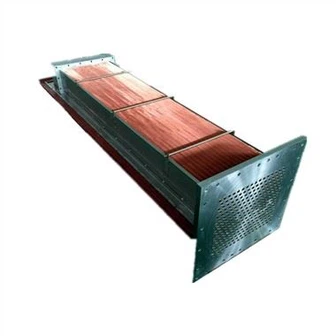
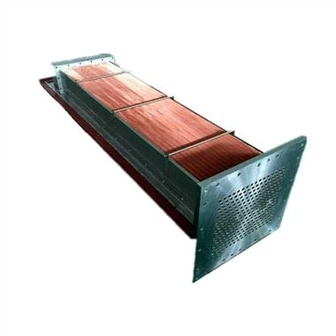
Remote Radiator For Solar Power Systems
Although a lot of heat must be removed to condense the steam used to power turbine generators, cooling systems are typically the main supply of water for power plants. Water sources like rivers and lakes have historically provided this cooling, but in recent years, there has been an increase in the number of power plants adopting dry cooling (a cooling system that uses little to no water). Dry cooling systems demand more energy to operate and have a higher initial cost. These issues all contribute to the power plants' overall reduced efficiency, yet dry cooling systems consume 95% less water than wet cooling systems.
Many power plants of different types produce electricity by heating water to create steam, which is then forced through turbines. This kind of system is used in some solar facilities as well as plants that burn coal and biomass, nuclear power plants, some natural gas plants, and nuclear plants. These plants' turbines must turn steam, which then needs to be cooled so it can condense back into liquid and be sent back to the boiler or steam generator.
The steam is often cooled and condensed using water in steam power plants. The US Geological Survey estimates that 40% of all water withdrawals in the US are used for power generating, the majority of which is for cooling.
Recirculating cooling systems that recycle cooling water are used in over 61% of US thermoelectric producing capacity. In these systems, the water is kept in closed-loop pipelines so that it can be recycled. 36% of thermoelectric capacity in the US comes from power plants using DC cooling systems. These systems pull copious amounts of water from neighbouring water sources to cool the condenser, then release the hotter water back into the original source.

The majority of the 3% dry and hybrid cooling capacity in the US has been operational since 2000. The ambient air is used by dry cooling systems to chill and condense steam. There are two types of these systems: direct systems and indirect systems. No water is utilised in direct dry cooling systems since ambient air is used to condense steam. In typical water-cooled condensers, the steam in indirect dry cooling systems is condensed, but the closed system's cooling water is left behind. No water is lost through evaporation as a result, which means that very little water is consumed.
Steam can be condensed using both water and air in hybrid cooling systems, which combine dry and wet cooling. When it's cooler outside, these systems are often built to function as dry cooling systems, and when it's hotter outside and dry systems are less effective, they work as wet cooling systems.
In the US, 83 facilities with dry and hybrid cooling systems and about 20 GW of steam generating capacity are in operation. Texas has the biggest dry cooling capacity (2.8 GW), followed closely by Virginia, although California has the most dry cooling systems (13). (2.4 GW).
Around 83% of the operating capacity for dry and hybrid cooling is provided by the most popular generation technology, the natural gas combined cycle (NGCC). Because natural gas combined cycle facilities need far less cooling per MWh than coal or nuclear reactors, dry cooling systems are typically more cost-effective for them. Dry cooling technique is used in US natural gas combined cycle facilities for more than 15% of their active production capacity.
For concentrating solar power systems, dry cooling is another appealing choice. Numerous modern concentrating solar power systems use dry cooling because they are situated in regions like the Southwest of the United States where water resources are few and solar resources are abundant.